.svg)
.svg)
Your next lateral hire could define the success of your upcoming quarter. For many mid-sized and enterprise organisations, securing the right talent at the right time remains a persistent challenge. As teams scale, delivery timelines tighten, and businesses expand into new markets, relying solely on entry-level or internal talent is often insufficient.
According to LinkedIn, nearly 70% of the global workforce consists of passive candidates, meaning they are not actively seeking new roles but are open to the right opportunity. This highlights the real challenge: finding, engaging, and hiring the right talent in a fast-moving, competitive market.
This is where lateral hiring makes a difference. Instead of investing time to train someone new, companies can tap into experienced professionals who already have the skills, industry knowledge, and expertise to contribute from day one.
In this guide, we’ll cover what lateral hiring is, how it works, the key benefits it offers, and best practices for executing a successful lateral hiring strategy that fuels business growth.
TL;DR
- Lateral hiring is the process of recruiting experienced professionals into roles at a similar level of seniority, skills, and responsibility, so they can contribute with minimal ramp-up time.
- Companies typically use lateral hiring when they need to fill specialised skill gaps, replace critical roles quickly, support business expansion, or scale teams without slowing delivery.
- The biggest advantage of lateral hiring is faster time-to-productivity, because experienced hires bring proven domain knowledge, decision-making ability, and practical execution capability from day one.
- Lateral hiring is different from leadership hiring and campus hiring: leadership hiring focuses on strategic direction, while campus hiring builds long-term entry-level talent pipelines.
- A strong lateral hiring strategy depends on clear role definition, targeted sourcing, fast evaluation, competitive offers, and structured onboarding to improve offer-to-join and retention outcomes.
- For organisations hiring across IT, BFSI, engineering, manufacturing, shared services, and GCCs, lateral hiring is often the most effective route to maintain continuity and build execution-ready teams.
- With domain-aligned recruiters, SLA-driven delivery, and flexible hiring models, V3 Staffing supports enterprises in securing experienced talent quickly and reliably.
What is Lateral Hiring?
Lateral hiring is the recruitment of experienced professionals into roles that match their current skills, responsibilities, and level of seniority. These candidates are usually sourced from other organisations within the same or related industries and are expected to contribute with minimal training.
Unlike campus or entry-level hiring, which focuses on developing talent over time, lateral hiring addresses immediate business needs. It allows organisations to bring in individuals with proven expertise and domain knowledge, ensuring faster productivity and reliable execution.
For many enterprises, lateral hiring is essential for maintaining continuity and supporting growth. Whether scaling a Global Capability Centre (GCC), expanding into new markets, or filling specialised roles, organisations often need talent with prior experience to deliver results without delay.
Example
A Global Capability Centre expanding its data engineering team may require professionals with expertise in cloud platforms and large-scale data systems. By laterally hiring experienced data engineers, the organisation can accelerate project delivery and maintain momentum without investing months in training.
With the concept clarified, let’s look at why organisations are increasingly prioritising this hiring approach.
Why Lateral Hiring Is Important for Enterprise Workforce Growth
Digital initiatives and rapid business expansion are increasing the demand for experienced professionals across industries. Whether developing AI-driven solutions, managing regulatory compliance in BFSI, or scaling manufacturing operations, organisations need talent that can contribute from day one.
India’s skills gap is also widening. The World Economic Forum estimates that around 63% of Indian workers will require training by 2030, while more than 70 million may not receive the upskilling they need in time. This makes it increasingly difficult for organisations to rely only on internal capability-building, especially when business timelines demand immediate results.
Lateral hiring provides access to professionals who understand industry practices, tools, and delivery timelines. Beyond technical expertise, these individuals bring decision-making ability and practical experience, strengthening team capability and ensuring reliable execution.
This approach is particularly valuable for:
- Global Capability Centres (GCCs) scaling technology and shared services teams.
- Product and platform-based technology firms aiming to reduce time-to-market.
- BFSI and engineering organisations navigating regulatory changes or expansion.
Such roles require experience and precision, making lateral hiring a practical choice for sustaining growth. It is also essential when building mid-to-senior leadership pipelines, where proven capability and business understanding are critical.
So, in which scenarios should organisations turn to lateral hiring? Let’s explore.
When Should Companies Use Lateral Hiring?
Organisations turn to lateral hiring when they require experienced professionals who can contribute immediately and minimise disruption to business operations. This approach is most effective when speed, specialised expertise, and continuity are essential.
1. Scaling Teams Quickly: During periods of rapid growth or new project launches, organisations need talent that can become productive without lengthy ramp-up times. Lateral hiring supports efficient team expansion while maintaining delivery quality.
2. Filling Specialised Skill Gaps: Industries such as IT, BFSI, engineering, and shared services often require niche expertise that may not be available internally. Lateral hires bring the domain knowledge needed to address these gaps and support complex business requirements.
3. Expanding into New Markets or Functions: When organisations enter new geographies or diversify into additional business lines, professionals with local market and regulatory understanding help accelerate the transition and reduce execution risk.
4. Replacing Critical Roles Without Disruption: The departure of key employees can affect productivity and team stability. Lateral hiring ensures continuity by quickly filling these roles with experienced professionals capable of maintaining operational momentum.
These scenarios highlight where lateral hiring is most relevant. Let’s now examine the tangible benefits it delivers
7 Benefits of Lateral Hiring for Organisations
Lateral hiring plays a vital role in building strong and resilient teams. By bringing in experienced professionals, organisations gain immediate access to expertise, industry knowledge, and execution capability.
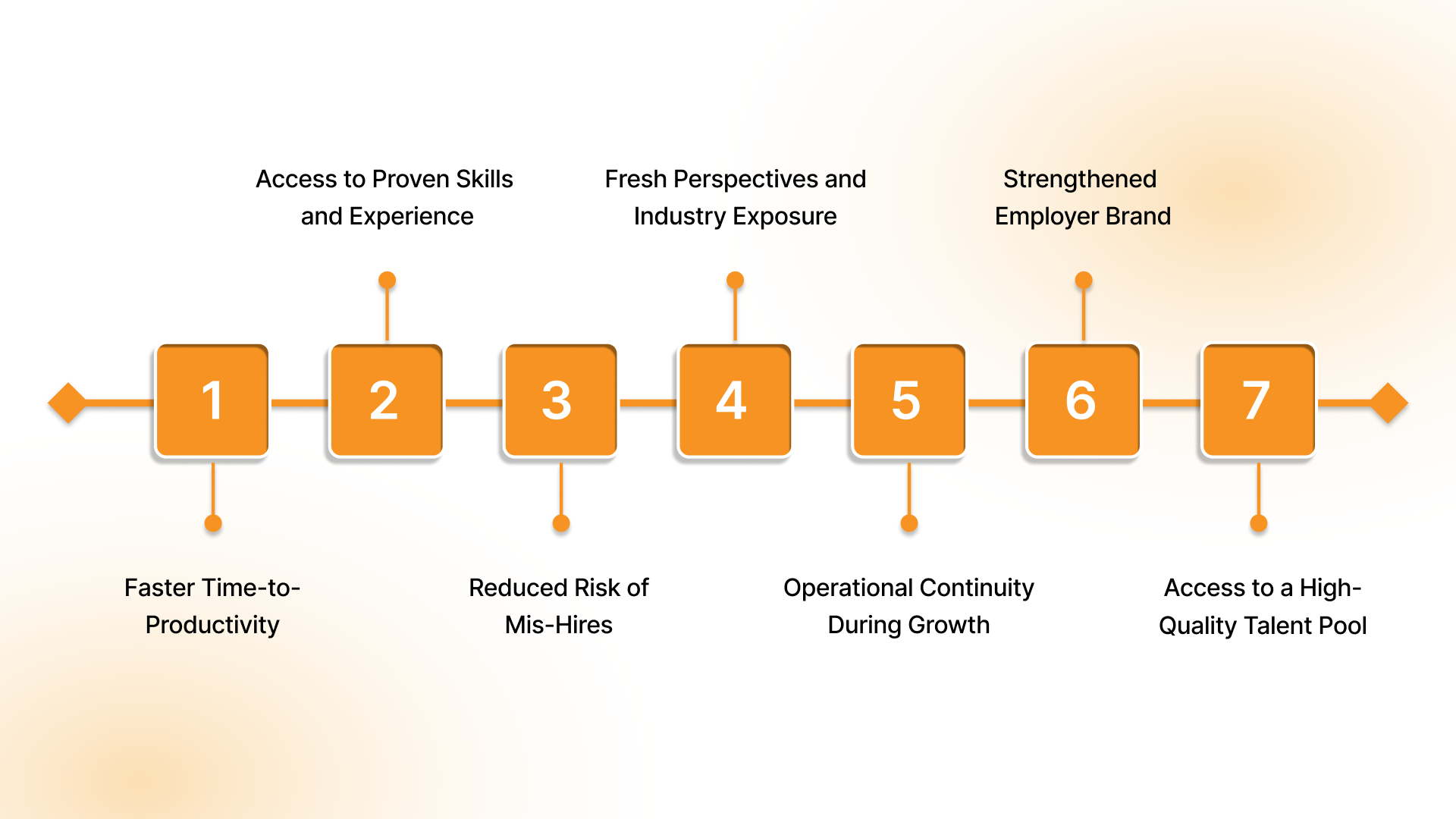
Here are the core benefits that make lateral hiring a preferred choice across Indian enterprises.
1. Faster Time-to-Productivity
Lateral hires are already familiar with the responsibilities of similar roles. Their understanding of industry tools, processes, and expectations allows them to integrate quickly and contribute with minimal onboarding.
This is particularly valuable in sectors such as IT, BFSI, engineering, and shared services, where delays in productivity can affect delivery timelines. For example, hiring an experienced QA Lead with expertise in test automation can significantly reduce a project’s ramp-up time.
2. Access to Proven Skills and Experience
Lateral hiring provides access to professionals with a demonstrated track record of success. These individuals bring practical insights and problem-solving capabilities gained from working in similar environments.
For Global Capability Centres (GCCs) and large enterprises, this ensures reliable execution and supports critical business initiatives from the outset.
3. Reduced Risk of Mis-Hires
Hiring mismatches can lead to lost time and increased costs. The U.S. Department of Labor estimates that a bad hire can cost at least 30% of the employee’s annual salary, making hiring accuracy a critical business priority. Lateral hiring mitigates this risk by targeting candidates who have already proven their ability to perform in comparable roles. Their experience and references offer greater confidence in their suitability, resulting in more stable and successful hires.
4. Fresh Perspectives and Industry Exposure
Professionals hired laterally bring insights from different organisational environments. This diversity of experience encourages new ideas, strengthens problem-solving, and supports the adoption of industry best practices. Such perspectives are particularly valuable in shared services and product-based organisations.
5. Operational Continuity During Growth or Change
During expansion, digital initiatives, or organisational restructuring, experienced professionals can step into critical roles quickly. Their ability to manage similar transitions helps maintain stability and reduces execution risk.
6. Strengthened Employer Brand
Attracting experienced professionals from peer or competitor organisations enhances an organisation’s reputation as an employer of choice. This credibility supports future hiring efforts and strengthens long-term workforce planning.
Over time, a strong employer brand supports long-term workforce planning and improves the effectiveness of talent acquisition efforts.
7. Access to a High-Quality Talent Pool
Lateral hiring broadens access to professionals who are already excelling in their roles. This creates a reliable pipeline of qualified talent for both immediate and future hiring needs, giving HR leaders greater flexibility in workforce planning.
To make informed workforce decisions, it is helpful to compare lateral hiring with other common hiring approaches.
Lateral Hiring vs Leadership vs Campus Hiring: Choosing the Right Talent Strategy
Organisations rely on different hiring approaches to meet both immediate and long-term workforce needs. Lateral hiring, leadership hiring, and campus hiring each serve a distinct purpose, helping businesses balance operational execution, strategic direction, and future talent development.
1. Lateral Hiring
Lateral hiring involves recruiting experienced professionals into roles with similar responsibilities and seniority. These hires bring proven expertise and can contribute almost immediately, making this approach ideal for addressing urgent business needs.
Best suited for:
- Scaling teams quickly
- Filling specialised skill gaps
- Replacing critical roles
- Supporting new projects or market expansion
Example: Hiring an experienced Delivery Manager to lead a new technology initiative.
2. Leadership Hiring
Leadership hiring focuses on senior executives or C-suite professionals responsible for setting organisational direction and guiding long-term growth. These roles have a broad impact on strategy, governance, and organisational performance.
Best suited for:
- Entering new markets or launching new business units
- Driving organisational or digital change
- Strengthening governance and strategic decision-making
Example: Appointing a Chief Technology Officer to define long-term technology strategy.
3. Campus Hiring
Campus hiring involves recruiting fresh graduates or early-career professionals to build a sustainable talent pipeline. While these hires require training and mentoring, they support long-term workforce development and succession planning.
Best suited for:
- Building entry-level talent pools
- Supporting succession planning
- Scaling junior roles through structured training programmes
Example: Recruiting graduate engineers for a management trainee programme.
Here are the key differences at a glance:
Most enterprises adopt a blended hiring strategy, combining these approaches to balance short-term execution with long-term capability building. While lateral, leadership, and campus hiring focus on different stages of talent acquisition, organisations must also decide whether to hire externally or develop talent internally. This is where understanding the difference between lateral hiring and vertical hiring becomes important.
Lateral Hiring vs Vertical Hiring: What’s the Difference?
While lateral hiring focuses on bringing in experienced professionals from outside the organisation, vertical hiring refers to filling roles through internal promotions or upward movement within the company. Both approaches play an important role in workforce planning, but they serve different business needs.
Lateral Hiring
Lateral hiring involves recruiting talent from outside the organisation into roles with similar responsibilities and seniority.
When to use:
- When internal talent is not available or ready
- When niche or emerging skills are required
- When speed of hiring is critical
Vertical Hiring
Vertical hiring refers to promoting or moving existing employees into higher roles within the organisation hierarchy.
When to use:
- When strong internal talent pipelines exist
- When succession planning is a priority
- When organisational knowledge is critical for the role
Here's a quick comparison:
Organisations typically use both: lateral hiring for speed and specialised expertise, and vertical hiring for internal growth and retention, balancing immediate impact with long-term development. Let’s now explore the functions and roles that benefit most from this approach.
Common Roles Where Lateral Hiring is Most Effective
Lateral hiring is most effective in roles where experience, domain knowledge, and immediate contribution are essential. These positions often involve critical decision-making or operational responsibility, making prior expertise indispensable.
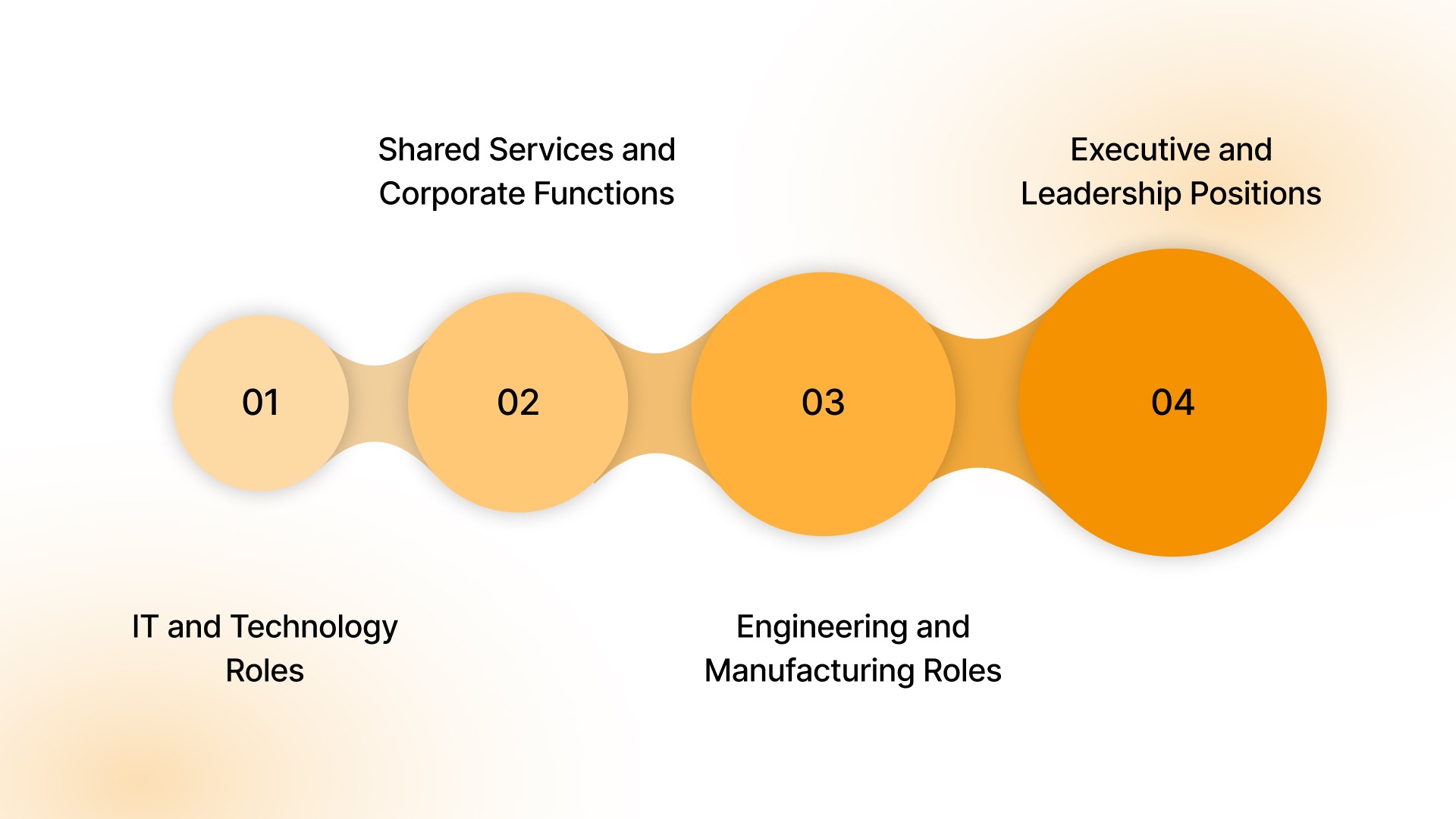
1. IT and Technology Roles
Examples: Software Engineers, DevOps Specialists, QA Leads
These roles demand hands-on technical expertise and familiarity with complex project environments. Lateral hires help maintain delivery timelines and bring stability to ongoing initiatives.
2. Shared Services and Corporate Functions
Examples: Finance Controllers, HR Business Partners, Operations Heads
Accuracy and compliance are vital in shared services. Professionals with prior experience in managing service-level agreements and internal controls ensure smoother and more reliable operations.
3. Engineering and Manufacturing Roles
Examples: Manufacturing Heads, Plant Managers, Supply Chain Leads
Execution-focused roles in engineering and automotive sectors benefit from professionals who understand plant operations, vendor management, and logistics, improving efficiency from the outset.
4. Executive and Leadership Positions
Examples: CXOs, Vice Presidents, Directors
Senior leadership roles require strategic insight and organisational maturity. Lateral hiring provides the stability needed during expansion, restructuring, or entry into new markets.
V3 Staffing supports lateral hiring across IT, shared services, engineering, and executive functions through domain-aligned recruiters and structured delivery models, ensuring consistent access to high-quality talent. Hire for your specific industry/roles.
Like any strategic initiative, lateral hiring comes with considerations that need careful management.
Key Risks in Lateral Hiring and How to Overcome Them
Lateral hiring provides quick access to experienced professionals, but it also presents challenges that can affect hiring timelines and long-term retention. A structured approach helps organisations manage these risks effectively.
1. High Competition for Top Talent
Experienced professionals often evaluate multiple opportunities, making it difficult to secure the best candidates.
How to overcome it: Streamline internal approvals and present a compelling employer value proposition that highlights career growth, role impact, and organisational stability.
2. Difficulty in Engaging Passive Candidates
Most lateral candidates are not actively seeking new roles, limiting the effectiveness of traditional job postings.
How to overcome it: Use proactive sourcing methods such as talent mapping, employee referrals, and personalised outreach to access high-quality candidates.
3. Compensation Benchmarking Challenges
Salary expectations for experienced professionals can vary widely, increasing the risk of offer rejections or internal pay disparities.
How to overcome it: Use current, role-specific market benchmarks and complement financial offers with benefits such as career progression and flexible working arrangements.
4. Cultural Fit and Retention Risks
Even highly qualified professionals may struggle to integrate if their working style does not align with organisational culture.
How to overcome it: Clearly define cultural expectations and incorporate behavioural assessments, supported by structured onboarding and mentorship.
5. Lengthy or Complex Interview Processes
Extended or unstructured interview cycles can lead to candidate drop-offs, especially when competitors move faster.
How to overcome it: Establish a clear interview framework with a limited number of rounds and communicate timelines transparently.
6. Integration and Over-Reliance on External Hiring
Without effective onboarding, experienced professionals may take longer to align with internal processes. Excessive reliance on external hiring can also limit internal talent development.
How to overcome it: Implement structured onboarding programmes and balance lateral hiring with internal mobility and succession planning.
So, how can enterprises execute lateral hiring effectively? Let’s break down the process.
How to Get Started with Lateral Hiring
Lateral hiring allows organisations to bring in experienced professionals who can contribute from day one. As these candidates are often well-established in their careers and not actively seeking new roles, a structured and discreet approach is essential for success. Here’s how you can execute lateral hiring:
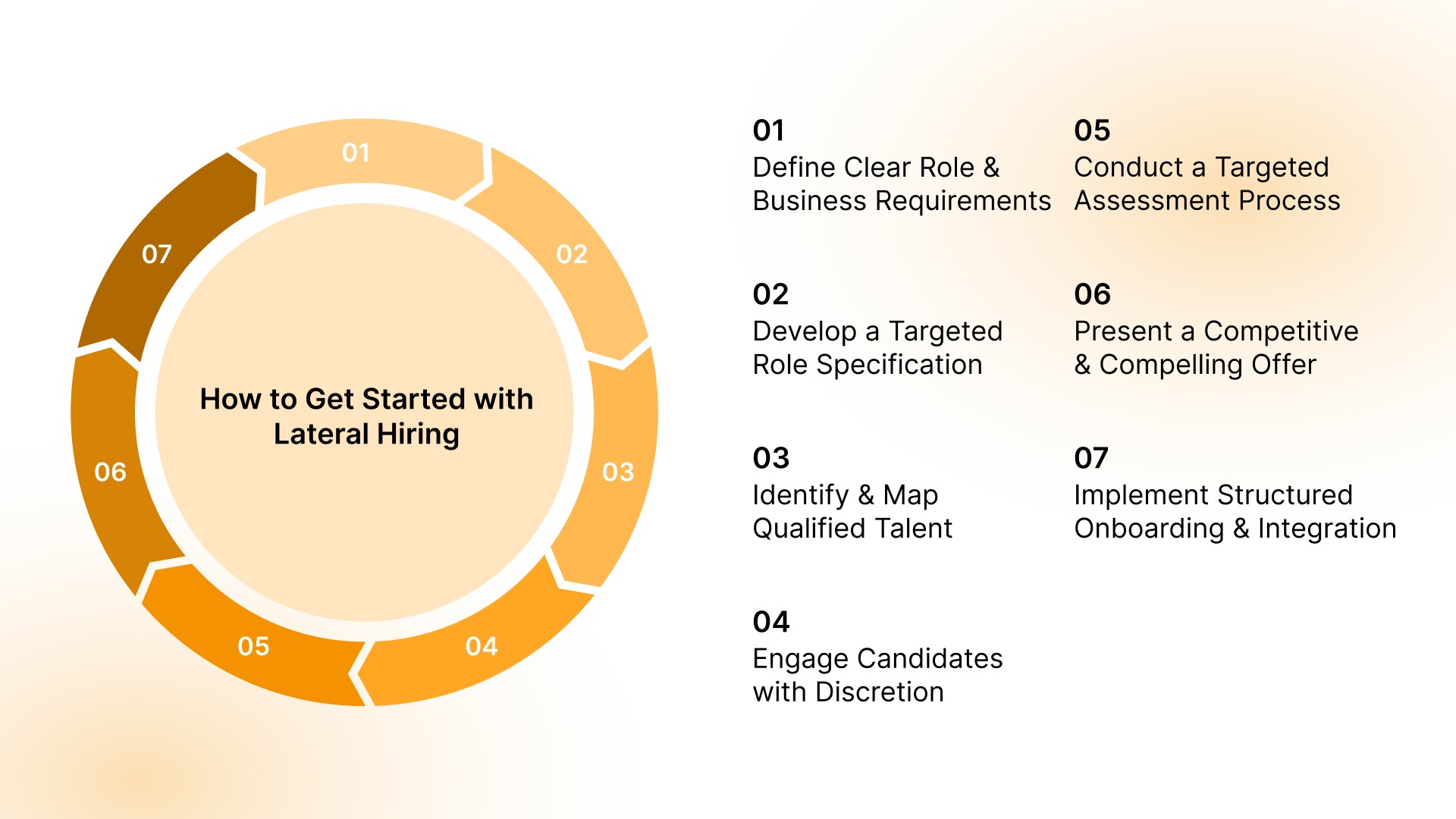
Step 1: Define Clear Role and Business Requirements
Begin by identifying the business need behind the hire. A well-defined role ensures alignment between organisational objectives and candidate capabilities.
- Clarify the business problem the hire will address.
- Define essential skills, competencies, and industry experience.
- Establish success metrics and performance expectations.
- Assess whether the role can be filled internally or requires an external hire.
- Align stakeholders on the role’s scope and objectives.
Step 2: Develop a Targeted Role Specification
A clear, outcome-driven role specification attracts candidates with the right expertise and sets expectations from the outset.
- Outline core responsibilities and measurable outcomes.
- Highlight required domain expertise and leadership capabilities.
- Specify essential qualifications and experience.
- Emphasise the strategic impact of the role.
- Ensure alignment on compensation range and reporting structure.
Step 3: Identify and Map Qualified Talent
Lateral hiring relies on proactive talent mapping rather than traditional job advertisements, enabling access to high-quality passive candidates.
- Map talent within target industries and competitor organisations.
- Leverage professional networks and employee referrals.
- Engage specialised recruitment partners with domain expertise.
- Participate in industry events and professional communities.
- Maintain a pipeline of pre-qualified candidates.
Step 4: Engage Candidates with Discretion
Since most lateral candidates are currently employed, confidentiality and professionalism during outreach are critical.
- Use personalised and confidential communication.
- Clearly communicate the strategic value of the opportunity.
- Respect the candidate’s privacy and current commitments.
- Share only relevant information during initial discussions.
- Build trust through transparent engagement.
Step 5: Conduct a Targeted Assessment Process
A structured evaluation ensures candidates possess the technical expertise and cultural alignment required for success.
- Implement competency-based and behavioural interviews.
- Use case studies or technical assessments to validate expertise.
- Involve key stakeholders in the evaluation process.
- Assess leadership and collaboration capabilities.
- Evaluate cultural and organisational fit.
Step 6: Present a Competitive and Compelling Offer
Experienced professionals often consider multiple opportunities. A well-structured and timely offer increases the likelihood of acceptance.
- Benchmark compensation using current market data.
- Include incentives such as signing bonuses or retention benefits.
- Highlight career progression and leadership opportunities.
- Offer flexible working arrangements where appropriate.
- Communicate the offer promptly to prevent candidate drop-off.
Step 7: Implement Structured Onboarding and Integration
Effective onboarding ensures that lateral hires integrate quickly and begin delivering value.
- Design a tailored onboarding programme with clear milestones.
- Assign an internal mentor or buddy from day one.
- Facilitate introductions to key stakeholders and teams.
- Provide clarity on performance expectations and organisational goals.
- Schedule regular check-ins during the initial months.
Pro Tip: Assigning an internal mentor significantly improves the integration of lateral hires. This support helps new employees navigate organisational dynamics, build relationships, and apply their expertise effectively.
The 7-Step Lateral Hiring Checklist
- Define the Role Clearly: Ensure the job description is detailed with required skills and experience.
- Target the Right Talent Pools: Use specialized job boards, professional networks, and recruitment partners.
- Engage Passive Candidates: Reach out to top talent who are not actively seeking new opportunities.
- Screen for Cultural Fit: Assess candidates for their compatibility with company culture and team dynamics.
- Evaluate Technical Skills: Implement skills-based assessments or case studies to evaluate expertise.
- Present a Competitive Offer: Benchmark salaries and benefits to attract top talent.
- Provide Structured Onboarding: Integrate the new hire into the company quickly through targeted training and mentorship.
For many organisations, partnering with an experienced recruitment provider simplifies this process and ensures consistent hiring outcomes. V3 Staffing helps organisations execute lateral hiring efficiently through domain expertise and structured recruitment processes.
How V3 Staffing Supports Lateral Hiring Across Industries
V3 Staffing partners with enterprises to deliver experienced, role-ready talent through structured and domain-specific recruitment approaches. With a strong focus on reliability and alignment with business objectives, V3 Staffing supports organisations in building high-performing teams across multiple industries.
- Domain-Aligned Recruiters: Recruiters with sector expertise in IT, BFSI, engineering, manufacturing, and shared services ensure precise candidate evaluation and strong role-to-talent alignment.
- SLA-Driven Delivery: Defined service-level agreements provide clarity on timelines and accountability, helping organisations fill critical roles efficiently while maintaining hiring quality.
- Pan-India Talent Reach: A strong presence across major metropolitan and emerging cities enables access to diverse talent pools, supporting both regional expansion and large-scale hiring needs.
- Flexible Hiring Models: V3 Staffing offers permanent recruitment, temporary and contract staffing, Recruitment Process Outsourcing (RPO), executive search, and global hiring support, allowing organisations to scale their workforce as business needs evolve.
- Offer-to-Join Management and Reporting: Proactive candidate engagement throughout the hiring lifecycle helps improve offer acceptance and ensures continuity in the recruitment process. Structured progress updates provide stakeholders with clear visibility into each stage of hiring.
We work closely with talent heads, business unit leaders, and HR teams across GCCs, high-growth startups, multinational corporations, and Indian firms to simplify lateral hiring and deliver results faster. Hire effortlessly with us
Conclusion
Lateral hiring isn't about simply filling positions but building future-ready teams with precision and speed. As talent gaps continue to challenge Indian enterprises, success lies in adopting structured hiring practises, engaging the right candidates, and maintaining recruitment agility across roles and locations.
Whether you are expanding a technology team, building shared services, or strengthening leadership across business units, successful lateral hiring requires the right expertise and execution. Partnering with a recruitment specialist can help ensure consistency, speed, and better role-to-talent alignment.
V3 Staffing supports enterprises with domain-aligned recruiters, SLA-driven delivery, and a strong pan-India presence. If you are looking to strengthen your lateral and leadership hiring strategy, speak with our hiring specialists to explore how we can support your talent needs.